Housing association common areas: what to maintain and when
The Abimeister team · Updated · 2 min read
An association's budget overruns in two ways: an unexpected emergency, or maintenance that was skipped until it became one. The list below is deliberately short — these are the places where a little money prevents a lot.
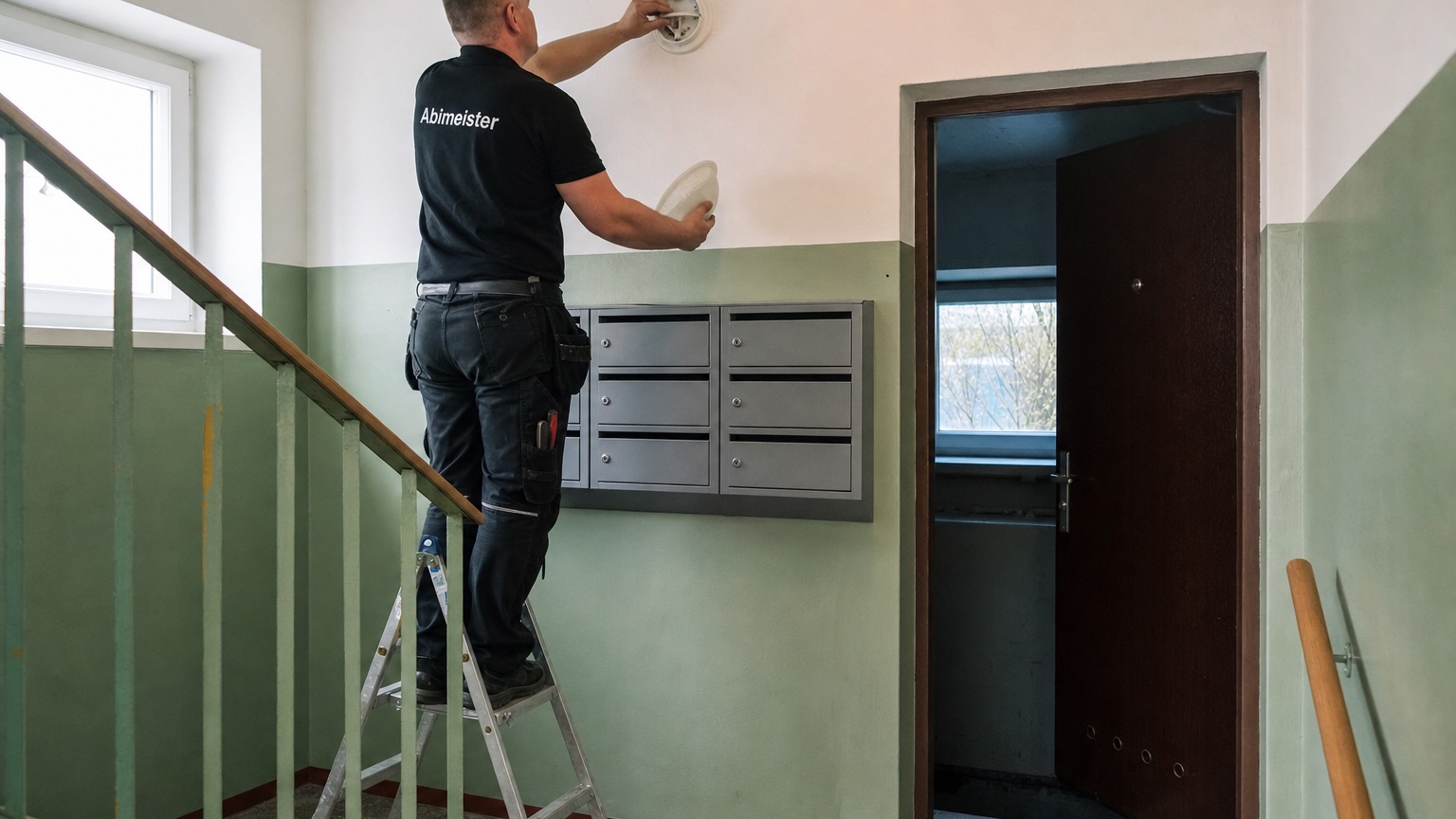
Twice a year
Gutters and downpipes in spring and autumn. A blocked gutter drives water against the plinth, and plinth repair costs many times what the cleaning did.
Stairwell lighting and motion sensors. Failed bulbs are a visible nuisance; a broken sensor that leaves the light on all night is an invisible cost that shows up only on the bill.
- Clearing gutters and downpipes (spring, autumn)
- Checking stairwell lighting and sensors
- Inspecting the cellar and loft for damp
- Checking the stairwell door closer and lock
- Checking that fire doors actually close
Once a year
Inspect the ventilation risers. If residents in several flats complain of mould, that is not a problem with the flats — it is a riser problem and the association's job.
Inspect the consumer unit and common-area connections, with a written report. That is the document an insurer asks for, and its absence is expensive exactly when something has happened.
A visual inspection of roof and facade, preferably in spring after the snow has gone. A small roof leak costs hundreds to repair; the same spot three years later costs tens of thousands.
Keeping the cost under control
Agree who may order work on the association's behalf. The commonest double cost arises when three flat owners order the same job from three different firms.
Require a short report with photos for every job. That is not bureaucracy: at a general meeting a photo is the only thing that ends the discussion about whether the work was done.
Where the money comes from: the sinking fund and the plan
An association with no sinking fund pays the most for every job: an extraordinary meeting, a one-off levy, and a contractor chosen in a hurry. The fund is not a saving, it is bought time — it lets work be ordered when it is cheap rather than when the roof is already leaking.
The practical minimum is a written five-year plan: what is already old, what comes next, and roughly what it costs. It does not have to be accurate. The only thing it has to do is turn the discussion from 'should we do this at all' into 'do we do it this year or next'.
With a plan in place, asking for quotes gets easier too. A contractor who knows you have planned three years ahead gives a different price from one looking at an emergency call-out with a broken stairwell door.
- Write down the age of every major system: roof, pipework, board, facade
- Estimate the remaining life of each in years, not to the month
- Record which year you plan what, and the estimated cost
- Review the plan once a year at the general meeting
- Ask for quotes before emptying the fund, not after
An annual maintenance plan costs less than one emergency call-out and makes the association's budget predictable.