Electrical safety at home: what to check yourself
The Abimeister team · Updated · 3 min read
Most domestic electrical problems announce themselves before anything happens. The signs are simple, and checking for them needs no tools and no knowledge — only fifteen minutes and attention.
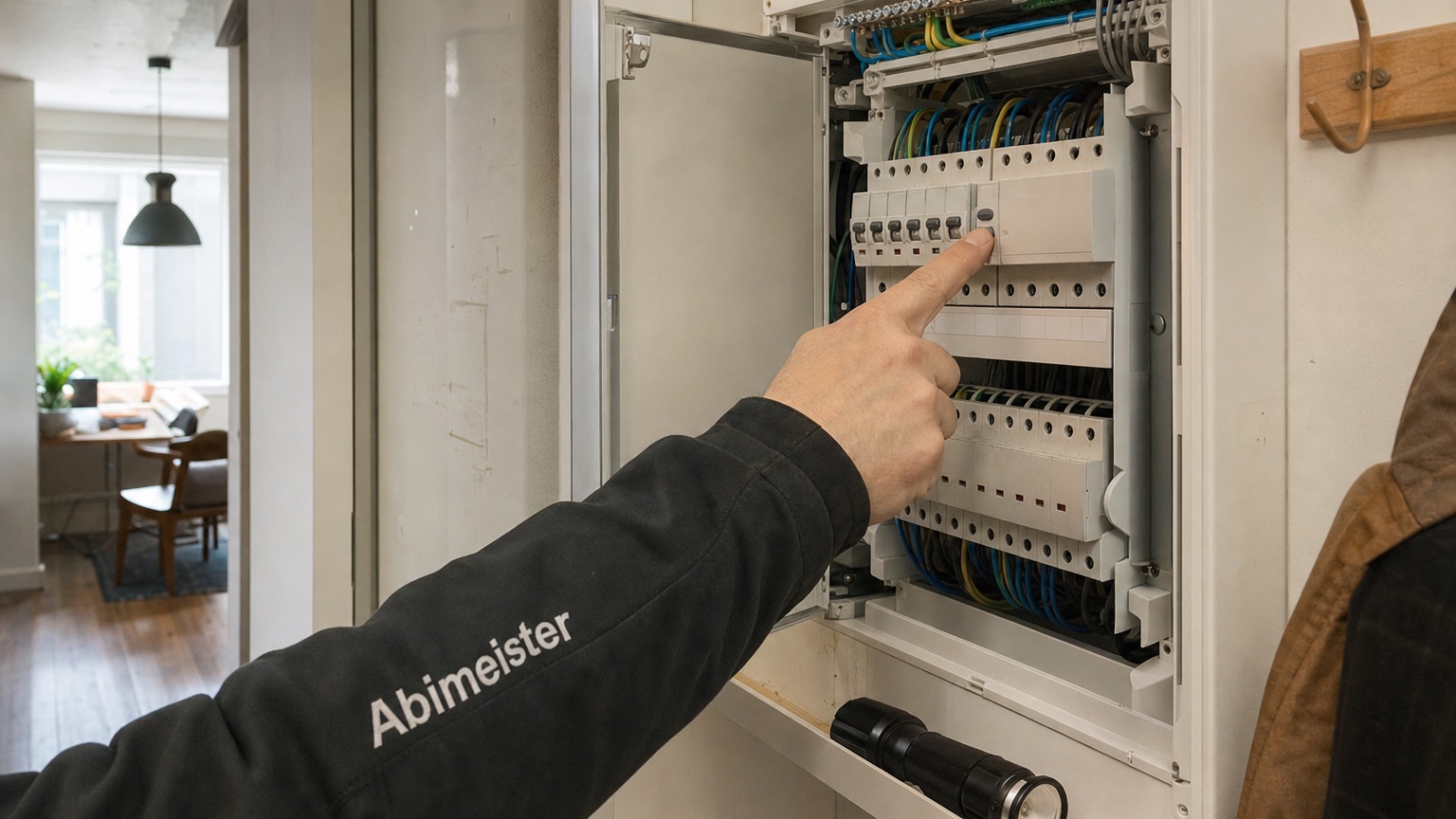
Checks you can do yourself
Look at the board. If it has rewireable fuses rather than breakers, the board is at least forty years old. If there is no RCD, the system protects the cables but not the people.
If there is an RCD, test it. The button marked 'T' or 'Test' must trip it. Do this twice a year; if it does not trip, the protection is not working, and that is serious.
- The board has breakers, not rewireable fuses
- An RCD is fitted and its test button works
- No socket is warm to the touch or discoloured
- Extension leads are not daisy-chained or run under rugs
- Bathroom sockets have covers and are far enough from water
- No cable is crushed under a door, in a window or behind furniture
Three signs that need an electrician now
A burning smell at a socket or the board. There is nothing to investigate — switch the circuit off and call. A hot socket means a poor connection, and a poor connection means arcing.
A breaker that trips repeatedly. The breaker is doing its job; repeated tripping means something is telling you a fact. Do not replace it with a bigger one — that is exactly what overheats the cable.
A slight shock when touching an appliance. That indicates an earthing problem: unpleasant with dry hands, potentially fatal with wet hands in a bathroom.
What never to do yourself
Do not work inside the board. Changing a socket is borderline; behind the board there is live voltage even with the breakers off, because the incomer sits ahead of them.
Do not chain extension leads together or use them permanently for high-load appliances. A washing machine, a heater and a kettle each want their own socket and their own circuit.
What to do before the electrician arrives
Fifteen minutes of preparation halves the cost of fault finding, because the electrician does not spend the first hour establishing what you already know. The most useful thing is to note when the problem appears: always when the same appliance is switched on, only in rain, only in the evening — every such pattern narrows the search to one circuit.
The second preparation is access. The board is often behind a cupboard, in a hall unit or papered over. Clear access to it before we arrive and take a photograph — we can often tell from the photo alone whether the board needs replacing or one circuit will do.
Third: do not take anything apart before it has been tested. A half-dismantled socket makes the fault harder to find, not easier, and loose conductors in a wall are dangerous even with the breaker off.
- Write down when the problem appears and what triggers it
- Photograph the consumer unit and send it ahead
- Clear access to the board and to the faulty outlet
- Do not fit a larger breaker before the cause is known
- List everything on the same circuit: sockets, lights, appliances
The RCD test button is the cheapest safety device in the house. Press it twice a year.