Fixing heavy things to walls: the right plug for each wall
The Abimeister team · Updated · 3 min read
Estonian flats have four kinds of wall, and each wants a different fixing. Once you know which one you have, the rest is easy — and you can establish it with one nail and two minutes.
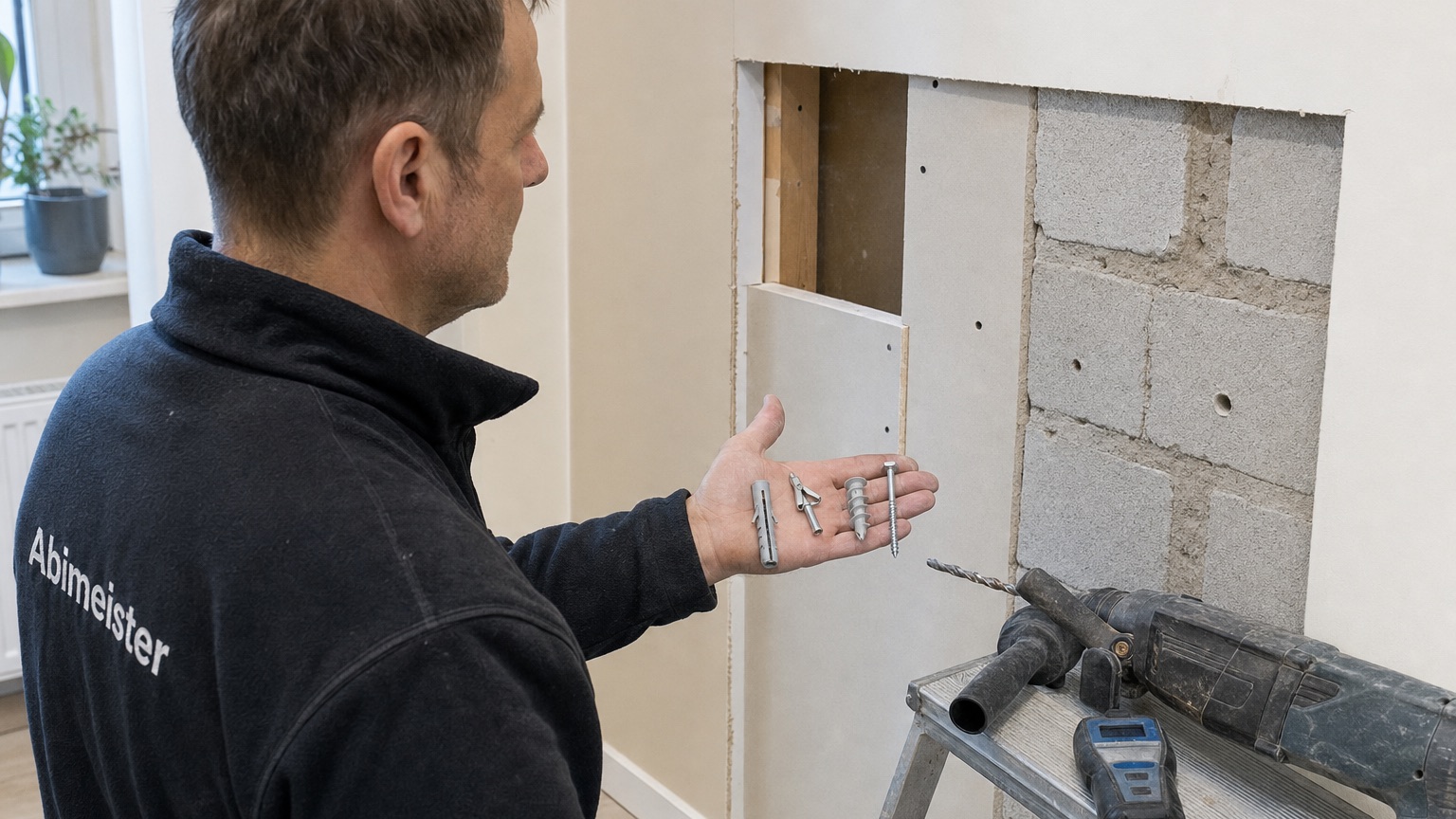
Identify the wall in two minutes
Knock on it. A hollow sound means plasterboard or old reed-and-plaster. A dull, solid sound means concrete or brick. Try a nail: it goes into plasterboard by hand, will not go into concrete at all, and goes a little way into brick with red dust.
When drilling, the dust colour tells you the rest: grey is concrete, red is brick, very fine white is plasterboard, and soft yellowish dust with plant fibre in it is the old reed-and-plaster found in the wooden houses of Tallinn and Tartu.
A fixing for each wall
No ordinary plug carries a heavy load in plasterboard. Up to 10 kg a nylon cavity fixing is enough; above that you need a metal toggle, or you fix into the steel stud behind — which is the most reliable option of all.
Concrete and solid brick carry almost anything, provided the hole is the right size and deep enough. The commonest mistake is an oversized drill: if the plug goes in without resistance, the hole is already spoiled and no longer screw will save it.
- Plasterboard up to 10 kg: nylon cavity fixing
- Plasterboard over 10 kg: metal toggle, or fix to the stud
- Concrete and solid brick: standard nylon plug, correct drill
- Hollow brick and block: long plug or chemical anchor
- Old reed-and-plaster: chemical anchor, always
Three rules that prevent an accident
First: check for cables. Wiring normally runs vertically up or down from switches and sockets. The usual height for a shelf is exactly that zone.
Second: spread the load. Two fixings carry far more than one twice as strong, because the load is no longer purely pull-out.
Third: allow for leverage. A deep shelf or an articulated TV bracket generates a much greater force at the wall than the object's weight — the manufacturer's load figures assume the weight sits against the wall, not out from it.
How much does the thing you are hanging weigh
Choosing a fixing starts with weight, and people consistently underestimate it. A bookshelf is light empty and heavier than a small adult when full. Always work from the loaded weight, not from what it weighed in the shop.
The safe rule is double the margin. To hang 20 kg, pick a fixing the manufacturer rates at 40 kg — that covers both shock loading and the fact that your wall is not perfect. Load ratings on a manufacturer's page apply to solid concrete, not to the wall you actually have.
If in doubt, pull on it before you load it. A fixed anchor should take your whole body weight hanging off it for a moment — if it moves, it will not hold the shelf either.
- A full 1 m bookshelf: 25–40 kg
- A 55-inch TV with its bracket: 20–30 kg
- A large wall mirror: 15–45 kg
- A kitchen wall unit full of crockery: 40–60 kg
- A hanging chair or a punchbag: reckon three times the user's weight
The right fixing costs under a euro. The tiled floor under a fallen mirror costs hundreds.