Furniture assembly: seven things the instructions leave out
The Abimeister team · Updated · 2 min read
A flat-pack instruction sheet assumes a level floor, two people and patience. In practice you have one of the three. These tips come from thousands of assembled units and save the most time.
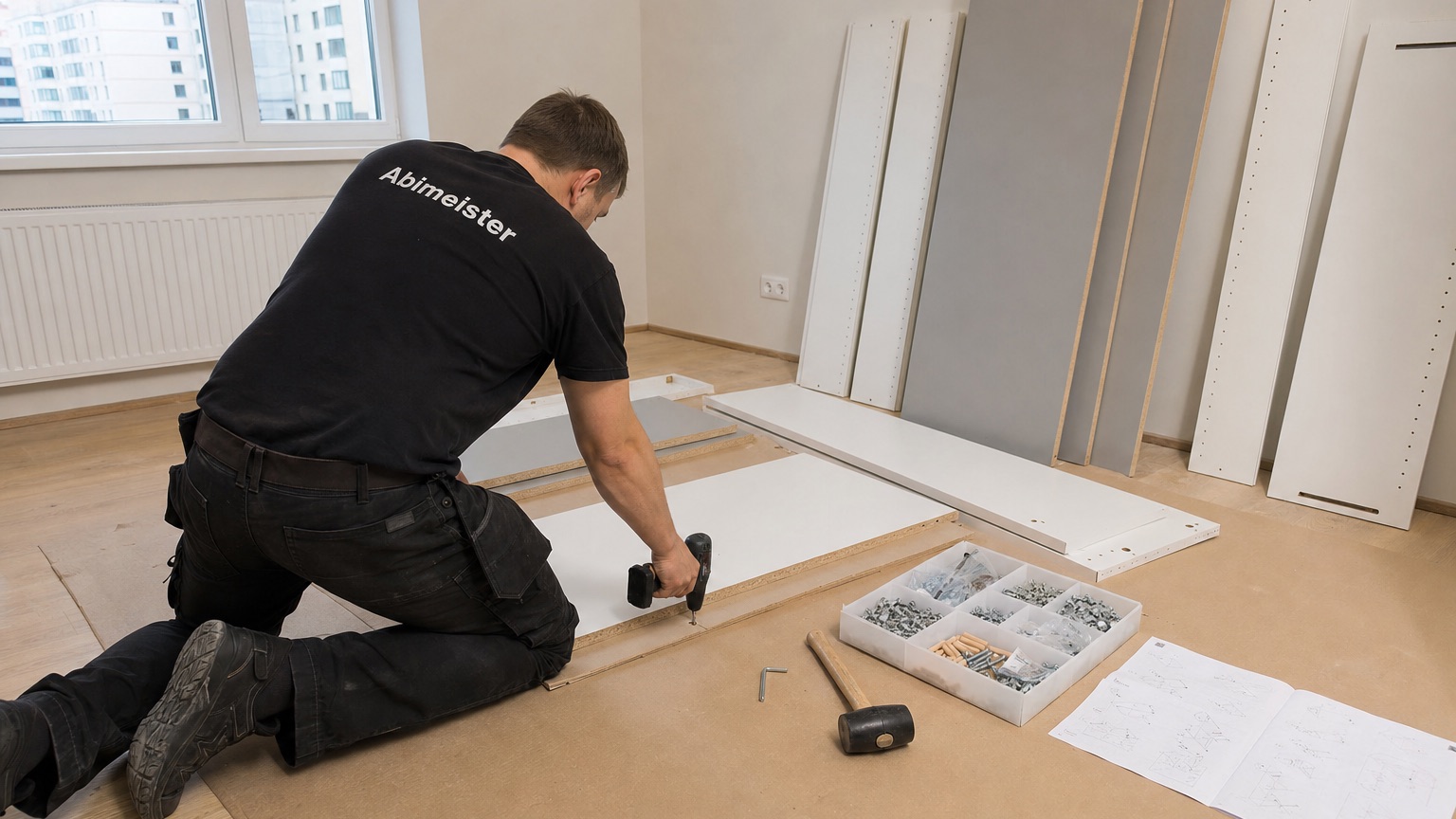
Before you turn the first screw
Unpack everything and lay it out. Discovering a missing part at step three means dismantling half the job; discovering it at the start means one phone call.
Protect the floor with cardboard, not just the shop's plastic. Cabinet edges scratch laminate on the very first turn, and that cannot be undone later.
Three mistakes that cost the most time
First: tightening screws fully before the whole carcass is together. Chipboard does not give, so the last corner will not meet. Run everything in loosely, check the diagonals, then tighten.
Second: fixing the back panel before checking the carcass is square. The back is what holds a cabinet square — nail it onto a skewed carcass and the unit stays skewed forever.
Third: assembling upright. Almost every cabinet is built lying down and then stood up. Built upright, one person carries the whole weight and the precision goes.
- Lay the parts out and count them
- Run every screw in loosely first
- Check the diagonals before the back panel
- Build flat, then lift
- Always fix anything over 1.2 m tall to the wall
Fixing to the wall is not optional
Every tall unit and chest of drawers has to be fixed to the wall. The fixing in the box is meant for a timber wall; plasterboard needs a cavity fixing and concrete needs a plug and the right drill.
If the unit will carry weight — books, crockery, tools — check the shelf ratings. Most mass-market shelves are rated for clothes, not a library, and bow within a year.
The tools that actually matter
The allen key in the box works, and it is the reason assembly takes three hours. Four tools turn the same job into an hour's work and cost less between them than one wardrobe.
A cordless driver with an adjustable clutch is the important one. Set it low — about a third of maximum — so the screw does not chew the hole round in chipboard. That single setting is what separates a unit that stays solid from one that starts to wobble.
The second is a spirit level. The floor is never flat, and a cabinet set to the floor is visibly crooked the moment a second cabinet stands next to it.
- Cordless driver with an adjustable clutch, set low
- A spirit level, at least 40 cm — a phone app is not a substitute
- A rubber mallet for dowels and the back panel
- A set of allen keys: the one in the box wrecks your wrist
- Cardboard or an old blanket to protect the floor
Two hours of assembly is normal. Four usually means one step was done out of order — and then it is worth undoing that one step rather than pushing on.